

Housing and affordability for the working poor
By Ben Quam
Saint Paul doesn’t build enough housing. Since 2015, Roseville built 10% more, Minneapolis 75% more, and Woodbury 137% more.
Why has Saint Paul built so little new housing in the past decade? We covered this earlier at Sustain Saint Paul: rent control policies, restrictive zoning, and slow permitting.
The lack of new housing has worsened Saint Paul’s affordability crisis in three ways:
Increased home prices
Greater tax burden
Worsening costs for workers
These effects are hardest on low-income workers. Saint Paul has progressive, liberal values, but for us to truly be a welcoming and affordable city, we must build enough housing so working-class people can afford to live here.
Home Prices
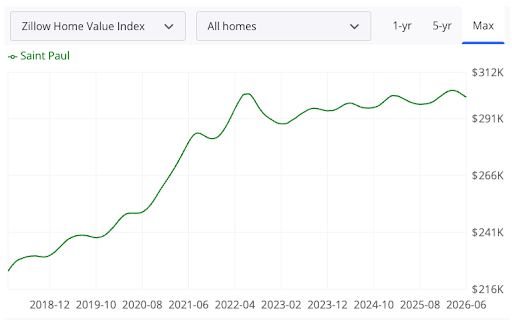
Saint Paul homes have become much more expensive over the last ten years. From 2018 to 2026, average home prices in Saint Paul climbed 35% from $228,000 to $309,000, according to Zillow. Prices rose massively before and during the pandemic, and have continued to climb steadily even after interest rates rose in 2022.
That means buying a home is 35% more expensive than it was in 2018. Blocking new housing directly causes home prices to rise. When there is a fixed, scarce supply of housing, it caps the number of people who can move to Saint Paul. Because supply is limited, buyers bid up the prices. A 20% down payment on a median home in Saint Paul is now over $60,000. For a young teacher, nurse, or social worker, those costs can put home ownership out of reach.
This worsens income inequality between homeowners and renters. Existing homeowners can capture the wealth from rising home values by selling their house or tapping a home equity loan. For those trying to buy a house, young shoppers with deep family support can compete or buy their family home off-market. Moderate-income renters who can’t tap other resources are locked out.
When existing homes are put up for sale, scarcity means new residents with money buy them up, while those with less must choose between spending a disproportionate amount of their income on housing or move elsewhere.
Renting vs buying have different supply and demand markets, driven by interest rates, wages, and other factors. But overall housing scarcity also worsens options for renters.
I now own a home, but when I was a renter, my landlord complained loudly about new-build apartments. He called the units in my building “luxury apartments” and charged as much as he could. My apartment was fine, but it was not “luxury”. The building was built in 1964. The unit was small. It was totally average.
My landlord saw new, big apartment buildings with swimming pools and gyms for what they were: a threat to his monopoly on housing. And especially a threat to his ability to charge “luxury” pricing for mid-tier apartments.
I was lucky to be able to afford to stay in my neighborhood, but low-income renters face a hard decision each year. Researchers at the Urban Institute found that new housing supply is the best predictor of low-income residents' ability to stay in their neighborhood.
Taxes
The Saint Paul City budget has risen 70% over the last ten years, from $527 million in 2015 to $887 million in 2026. Whatever you think of city spending, much of that increase has come from inflationary wage increases to retain city workers. If we want to sustain city services, we need to grow the city tax base.
While the budget has swelled, the tax base has not. And while events outside city hall’s control, like COVID, Madison Property’s collapse, and de-industrialization, have contributed, city policy is also to blame. By making it difficult or impossible to build new housing, the city government has pushed the growing tax burden onto current Saint Paul residents.
Since 2020, property taxes have risen over 25%. Saint Paul property tax rates are significantly higher than suburbs like Roseville or Woodbury. These tax rates are an important factor for middle class workers looking to buy a home. Along with prices, they push middle-class homebuyers away from Saint Paul into the outer suburbs.
This is a policy choice. Sustain Saint Paul has shown that new housing, especially dense housing, is extremely effective at generating new tax revenue. Saint Paul should open our doors to new housing and residents who will help fund essential city services.
Costs for Workers
Along with home prices and tax increases, housing scarcity drives up the cost of transportation and every other personal budget item.
Housing is transformed into a transportation cost. Because workers can’t afford to live close to work, they have to live farther away and eat the transportation costs. This forces workers to need their own car and commute longer, driving up commute expenses, traffic, and lost time. When it becomes harder to live close to family, childcare or eldercare costs increase or become impossible.
This housing cost also transforms into broader inflation: small employers in restaurants or shops must pay more to attract workers to travel longer distances. The cost gets passed on to consumers in higher prices.
When housing costs push up to 40% of total income, it crowds out spending on healthcare or savings. This means low-income workers are less healthy and less secure if they suffer a medical emergency or lose their job.
Housing scarcity is a burden that is hardest on the poor. Bloomberg City Labs found that “even expensive new units in wealthy areas help relieve pressure on rents across the market, including in less-affluent neighborhoods.”
A working-class, progressive agenda must prioritize cost of living for nurses, child care workers, and teachers so they can affordably move to our city. Today, Saint Paul artificially limits how many homes we build. That must change.