

The three reasons it’s difficult to build housing in Saint Paul
By Luke Hanson, Co-Chair of Sustain Saint Paul
Saint Paul is an amazing place to live. But it’s no secret that our city has major fiscal problems. Property taxes have risen steeply in recent years, and residents– especially low-income homeowners and renters– have struggled to keep up. Meanwhile, streets and sewers around Saint Paul are crumbling more quickly than the City can afford to repair and reconstruct them. This year, as the City reckons with a $26 million budget gap, both sides of this fiscal conundrum may worsen.
The challenges are severe. And yet at Sustain Saint Paul, we remain confident that our city’s best days are still ahead of us. The path to a brighter future is to build more housing. Doing so is the City’s best strategy to increase its tax base. Housing currently accounts for 71% of the City’s tax base, and building more housing will make Saint Paul a more vibrant, inclusive, affordable city.
Saint Paul builds a lot less housing per capita than many other metro area municipalities. The table below uses housing production data from the Federal Reserve Bank of Minneapolis (for a 10-year period from 2016-2025) and the Metropolitan Council’s 2025 population estimates for several municipalities:
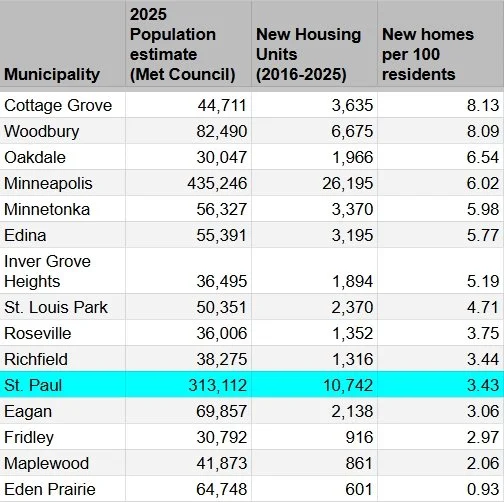
Saint Paul isn’t just being outpaced by Cottage Grove and Woodbury, who have sprawling new subdivisions. We’re also being outpaced by Minneapolis and first- and second-ring suburbs like Edina and Richfield. These places are subject to all of the same macroeconomic factors that Saint Paul is– high interest rates and commodity prices, a shortage of skilled construction labor, and so on.
So why has the pace of housing development in Saint Paul lagged behind several of our neighbors?
Here are a few of the reasons.
Rent stabilization
A recent report from the Federal Reserve Bank of Minneapolis makes it clear that Saint Paul’s rent stabilization ordinance has slowed housing development in Saint Paul. In the wake of the ordinance’s adoption in 2022, new housing production in Saint Paul suddenly dropped: whereas the City permitted 1,204 new housing units in 2023, it only permitted 404 new homes the following year. Although Minneapolis and other suburbs saw housing starts decline during the same period (likely because of rising interest rates and other macroeconomic factors), Saint Paul was worse, suggesting that local housing policies were also a cause.
Housing construction seems to have rebounded somewhat since last year, when the City Council voted to permanently exempt newly-constructed housing from the rent stabilization ordinance (at the urging of dozens of Sustain Saint Paul members and other advocates). Within a couple of months of the Council’s vote, housing construction had resumed at Highland Bridge. Let’s hope that these amendments to the ordinance clear the way for housing development to pick up speed in the coming years: it’s our best means of building a more vibrant and inclusive city for homeowners and renters alike.
Restrictive zoning
In 1975, Saint Paul adopted zoning rules that effectively blocked the development of new rental homes across the City: it reserved the vast majority of Saint Paul’s residential land for single-family homes. A person looking to build attainably-priced homes in those neighborhoods (e.g. duplexes, rowhouses, small apartment buildings) would first be required to navigate a lengthy bureaucratic process to request that the land be “rezoned” to allow them to build– without any certainty that their request would be met. By design, these rules stifled new housing development in most of Saint Paul for nearly fifty years– impeding the growth of our tax base and limiting affordable housing choices for first-time homebuyers and renters.
It’s no wonder that housing development happens slowly in Saint Paul: in many places, we require would-be developers to get local laws changed before they can build homes. It’s past time for the City to modernize its zoning rules and allow new housing by-right.
The City has made important progress on this front over the past few years– with significant public support organized by Sustain Saint Paul. In 2023, the City Council adopted major zoning amendments that effectively legalized rowhomes, backyard cottages, and 3-6 unit apartment buildings on nearly all of the city’s residential land. This was a huge step towards a more affordable and fiscally sustainable city for homeowners and renters.
But there’s far more work to do. The City can’t rely on small-scale infill housing alone to build the tax base and alleviate its local housing shortage: it should also upzone to allow larger apartment buildings, with 10, 20, 50, or 100 homes each, along key corridors. This year the City is making moves to do just that: the Planning Department plans to rezone land along six high-frequency bus corridors into the modernized Traditional Neighborhood zoning districts, which would legalize more housing, restaurants, coffeeshops, and other places that collectively form vibrant, walkable neighborhoods.
Cumbersome bureaucratic processes
In Saint Paul, anyone looking to renovate a house, build an apartment building, or start a new business needs to obtain approval and permits from the City’s Department of Safety and Inspections (DSI). Over the years, DSI has developed an unfortunate reputation for being a difficult office to work with.
In a recent column for MinnPost, Bill Lindeke described the dysfunction within DSI as a failure of communication– not only between DSI and other city departments, but also within DSI itself, such that “one hand doesn’t seem to know what the other is doing.” Combined with a thicket of seemingly arbitrary rules and regulations, DSI’s poor communications regularly result in projects getting delayed.
Complaints about DSI-related delays aren’t frivolous: these delays cost time and money. And these costs impose a disproportionate impact on builders of small-scale infill housing and would-be small business owners in particular: permitting delays mean additional months or years without revenue, and the risk of financial ruin. In the aggregate, DSI-related delays risk deterring folks from building homes in our city at all, reducing housing adoptions for renters, and making it more expensive to rent or buy a home.
Mayor Her’s administration appears committed to scrutinizing and streamlining DSI’s organizational structure and processes for the purpose of streamlining site plan reviews and permitting. Although DSI exists under the purview of the Mayoral administration, the City Council has also been devising their own ways to simplify the permitting process for home building: they are working to create a set of pre-approved building plans for small-scale housing. With one of these plans, a small-scale developer would receive automatic or expedited approval to construct a building on a compatible-sized lot in the city. Innovations like these promise to make housing development in Saint Paul faster and simpler.