

To Solve Saint Paul’s Fiscal Problems, We Need More Density
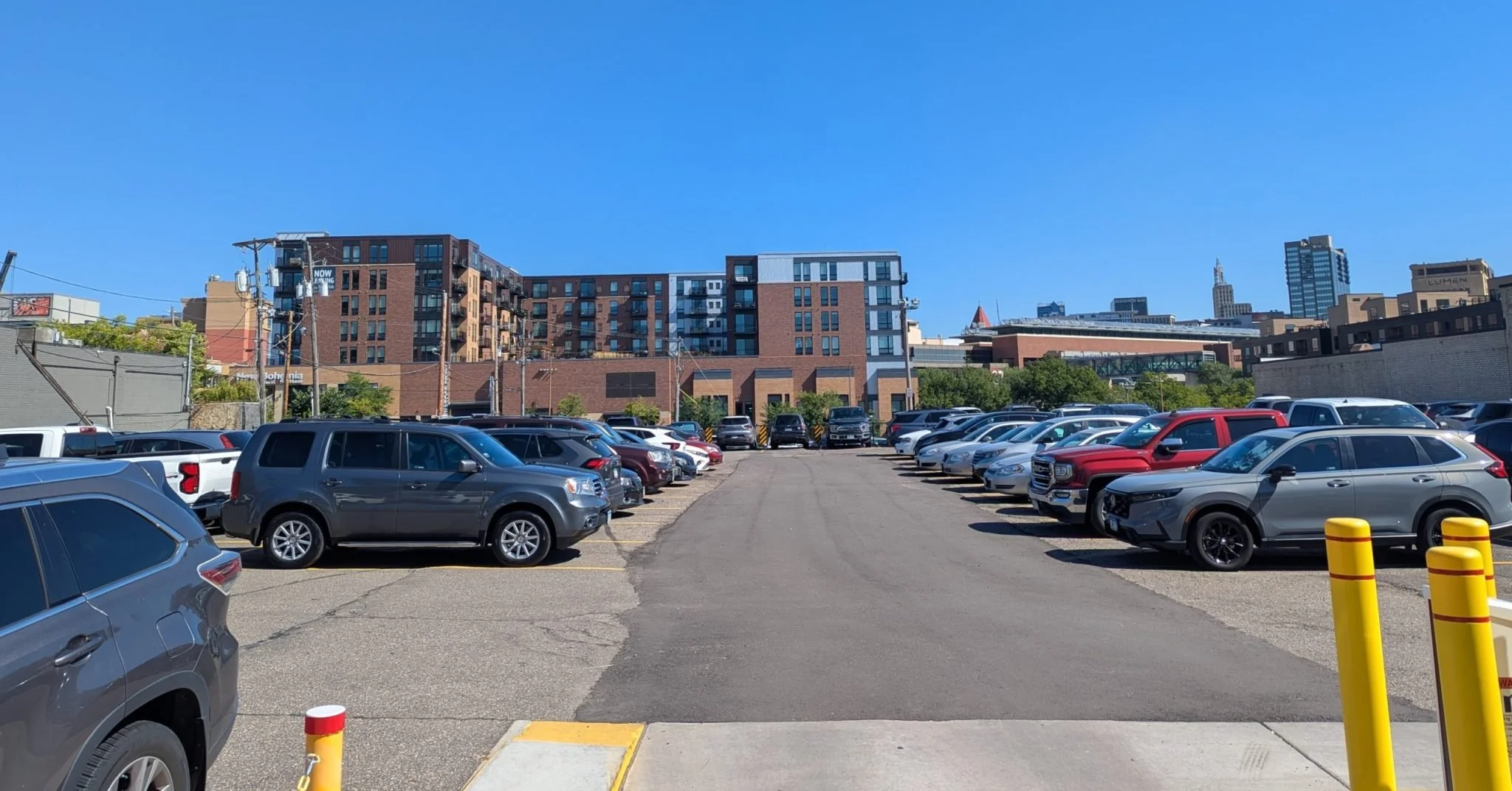
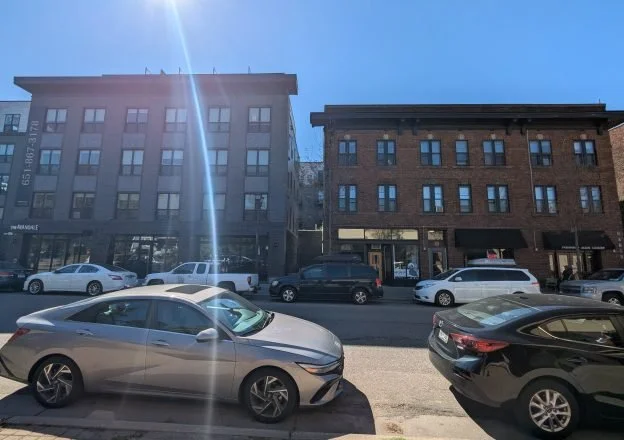
A sea of surface parking in the foreground, and the Oxbo Apartments on West Seventh Street behind.
By Luke Hanson
It’s budget season in Saint Paul — and as is so often the case, the City is facing a major budget gap. This year, the Mayor and the Council are reckoning with how best to close a $26 million deficit. The Mayor has proposed permanently closing an East Side library and rec center as a partial solution, setting up a fight with the City Council. Wherever the Mayor and Council ultimately land, it will likely include a combination of cuts to City programs and a property tax increase.
What’s especially worrisome is that these headlines are not at all unusual. To the contrary, they represent variations on the themes that have defined Saint Paul budget conversations for years: tax increases that outpace wage growth for ordinary residents, service cuts and deferring maintenance projects that would exacerbate those tax increases and service cuts if the City undertook them now.
It’s clear that our current fiscal trajectory is unsustainable, and that we must chart a new course. Some believe that the North Star of that new course should be fiscal austerity — a vision of a future where Saint Paul offers fewer public amenities and fewer taxpayer-supported programs and services. I have a different (and, I think, more optimistic) vision for the future: you might call it a vision of Abundance. I want Saint Paul to become a city that can afford all of the wonderful programs and services it currently offers, and maintain all of the parks and rec centers and streets and sewers and bridges it currently has, without unsustainable property tax increases. And I am convinced that the best North Star to pursue that vision for our collective future is to expand its property tax base — that is, to increase the collective taxable market value of all the land and buildings in the city.
Framing the Deficit
Expanding the property tax base is the most realistic way that Saint Paul can achieve long-term sustainable fiscal footing — more realistic than budget cuts. I am not altogether opposed to budget cuts — some will be necessary this year and in years ahead — but I am skeptical of the idea that the City could dramatically improve its finances by reducing spending. I suspect that there’s much less “fat” to cut from the budget than proponents believe.
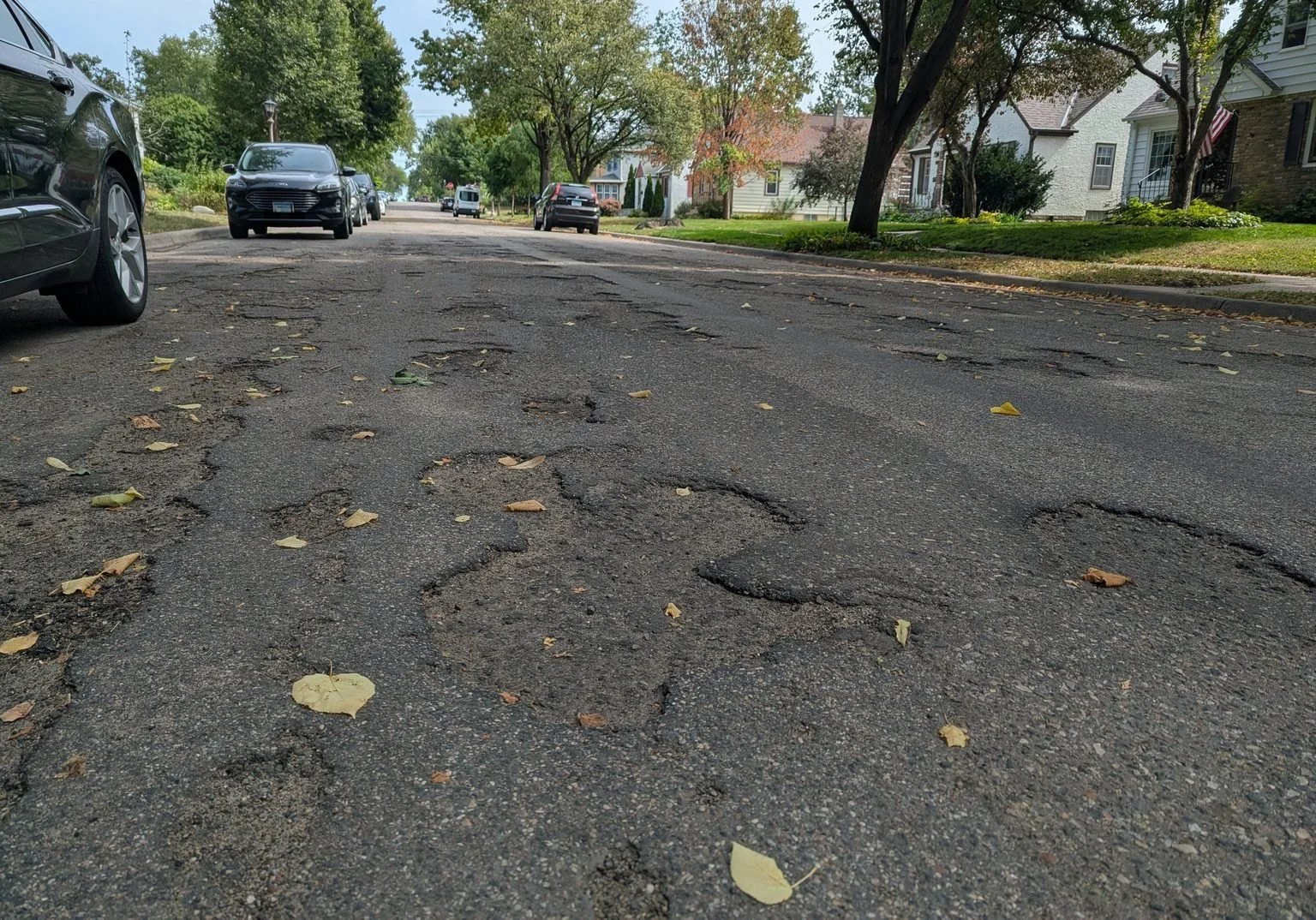
Potholes on an ordinary residential street in St. Paul. Photo credit: Luke Hanson
More than that, I suspect that for every million dollars of “non-essential” programs and services that could be cut from the City budget, there are many millions more in deferred maintenance expenses for which no funds have been budgeted at all. The Mayor’s summary of the proposed 2027 General Fund budget notes that it “establishes” a dedicated fund for the deferred maintenance of ~150 City-owned facilities (implying that one has not recently existed), with an estimated $1 billion in outstanding deferred maintenance. And that fund is only for city-owned buildings: it will do nothing to hasten the City’s dangerously slow pace of reconstructing only 1 to 3 miles of city-owned streets per year.
The Pioneer Press reported in 2019 that there are 762 miles of City-owned streets in Saint Paul; and that, if funding stayed flat, “at least 80 percent of residential streets will hit poor-to-failed condition by 2039, meaning more than 500 miles of road could become virtually un-navigable within 20 years.” Funding has not “stayed flat”: in 2023, Saint Paul voters passed a 1% Local Option Sales Tax (dubbed the “Common Cent” program) that is slated to fund the reconstruction of twenty-four heavily-driven arterial streets over a twenty-year period. The revenue from that sales tax is now the largest source of revenue for Saint Paul’s Capital Improvement Budget: about $85 million of the Mayor’s proposed 2027 Capital Improvement Budget of $195 million (see pages 6 and 7 of this PDF). But even still, there are hundreds of miles of streets in Saint Paul that will require full reconstruction in the next decade or two, and at current funding levels, we’ll only be able to reconstruct a small fraction of them.
I share all of this information to drive home a simple point: the City cannot fix its troubles simply by cutting staff and programs and reallocating existing revenue. It needs more revenue.
Revenue Struggles
Saint Paul gets its revenue from several different sources. But to raise the amount of additional revenue that Saint Paul will need for long-term fiscal stability, it should work aggressively to increase one source of revenue in particular: property taxes. To me, it seems unrealistic to think that other sources of revenue could (or should) generate larger proportions of its overall budget.
Beyond property taxes (which make up about 30% of the proposed 2027 City and Library budget, according to the pie chart on the last page of this PDF), the largest source of Saint Paul’s budget revenue are “Fees, Sales, and Services” (~13% of proposed 2027 General Fund revenues, 32.56% when “Special Funds” are added in). I’ll admit that I don’t know exactly which fees, sales, and services would be included in this slice of the revenue pie: perhaps fees from Public Works for garbage collection, for reserving city-owned park pavilions, for participating and Parks & Recreation programs and activities, and the like. In any case: I highly doubt that the City increasing these fees by 25% or 50% would solve its fiscal problems, or that tax-paying residents would find those increased fees to be reasonable. (I feel similarly about other, smaller slices of the revenue pie: “Licenses and Permits,” “Fines and Forfeitures.”)
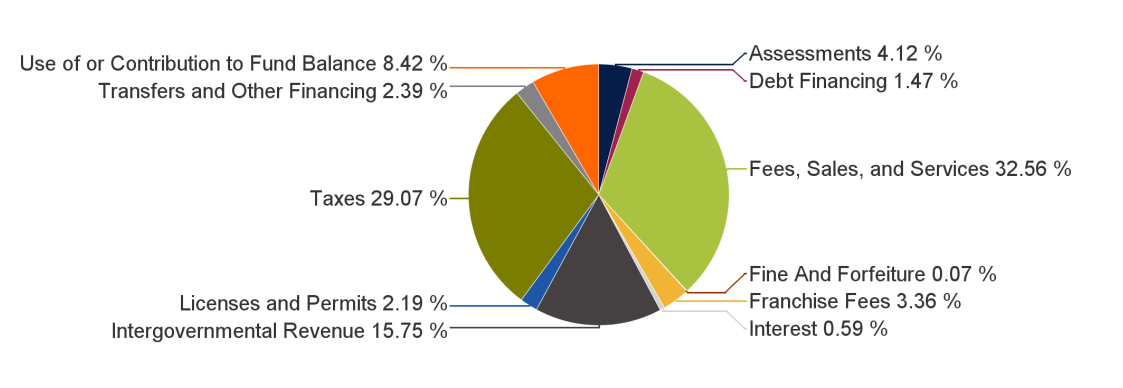
A pie chart showing revenue sources for the Mayor’s proposed 2027 City and Library budgets.
The next-largest source of budget revenue for Saint Paul (15.7% of the proposed 2027 budget) is “Intergovernmental Revenues.” It would be foolish to assume that the proportion of Saint Paul’s budget that comes from state and federal dollars will increase in the future; recently, it has been decreasing. As described on page 4 of this document about 2027 General Fund revenues, Local Government Aid from the State of Minnesota (a major chunk of Intergovernmental Revenues) have diminished significantly since they were un-indexed from inflation during Tim Pawlenty’s governorship in 2003. The last decade tells this story well. In 2017, Saint Paul received $62.6 million in LGA from the State. Adjusted for inflation, that’s about $85.3 million today — $3 million more than the City will receive in LGA in 2027.
The City likewise notes that “ongoing fiscal instability and uncertainty at the federal level adds pressure to the City’s budget outlook. Saint Paul relies on federal funding to support a wide range of services and infrastructure improvements.” These circumstances are not unique: many cities and counties in Minnesota have been reckoning with “state and federal funding changes that have shifted costs down to the local level,” such as major reductions in SNAP and Medicaid funding.
In sum: Saint Paul cannot solve its budget problems simply by increasing fees for services, nor can it depend on support from higher levels of government. The best and most realistic solution to its fiscal problems is to raise more revenue from local property taxes. And there are only two ways that a city can increase property tax revenues to satisfy its tax levy: (1) increasing the tax rate, or (2) expanding the tax base.
Searching for Revenue Sources
For years, Saint Paul has mostly been stuck between a rock (tax rate increases) and a hard place (belt-tightening budgets). To me, it’s clear that the best way to get “unstuck” is to expand the tax base. Saint Paul’s estimated tax capacity sits at $421 million; by comparison, Minneapolis (which has a similar land area and about 40% more residents) has a tax capacity of nearly $759 million — 80% larger than Saint Paul’s. We have so much room to grow.
Saint Paul’s path to tax base expansion is real estate development. In order for the City to raise more revenue (and ease the pace of tax increases for burdened residents), it needs the collective market value of all the land and buildings in Saint Paul to significantly increase.
Importantly, Saint Paul needs to generate more property taxes within the same finite amount of space within city limits. As a city, we need to concern ourselves not only with the taxable value of any given building: more specifically, we should be interested in a building’s taxable value relative to the amount of land it occupies — in other words, a building’s Tax Value Per Acre.
This is not an abstract concept. The Tax Value Per Acre of a parcel of land is a simple division problem that can be calculated with publicly available information: the assessed Taxable Market Value of the parcel, divided by the area of the parcel in acres. It is a measure of efficiency, much like a person would evaluate the fuel-efficiency of a gas-powered vehicle in Miles Per Gallon. (Side note: A parcel’s Tax Value Per Acre does not tell us the amount of tax revenue that a parcel generates relative to its land area; since there are other variables that can affect the amount of revenue that an individual parcel generates each year, I don’t find “Tax Revenue Per Acre” to be as straightforward to use as Tax Value Per Acre.”)
Last year, Ramsey County hired a consulting firm called Urban3 to produce and analyze a three-dimensional map of the Tax Value Per Acre of every parcel of land in the county. Here’s an image of that map:
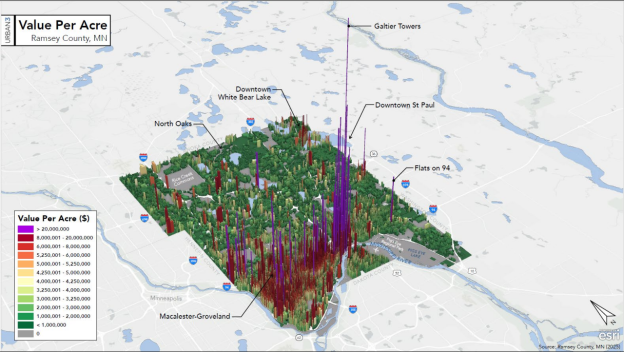
Here’s a screenshot of the Tax Value Per Acre map that Urban3 produced for Ramsey County (shared with permission); the land area of Saint Paul occupies most of the bottom half of the map. You can view an entire video and a slide deck from their presentation to the Ramsey County Board for more information. And here is a video of the same materials presented to a general audience at an event hosted by Sustain Saint Paul.
You’d be forgiven for thinking that this was some kind of “density” map, with the tallest spikes showing where the biggest buildings are located (high-rise towers in downtown Saint Paul, six-story apartments along University Avenue, etc.). The fact that this Tax Value Per Acre map looks like some kind of “density” map illuminates a fundamental fact: “dense” real estate development has a dramatically positive impact on Saint Paul’s tax base.
The parcels of land that contribute the most Tax Value Per Acre to our city tend to be the ones that are developed in the most “urban,” compact, land-efficient style: they are several stories tall, and/or they devote relatively small proportions of the land they occupy to lawns and parking lots.
The parcels of land that contribute the least Tax Value Per Acre to our city tend to be developed in a “suburban” style: they are often single-story buildings with large lawns and/or parking lots.
Let’s take a tour along West Seventh Street for a few examples.
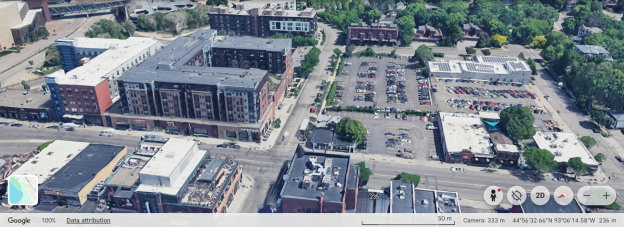
A Google Earth bird’s-eye view of two blocks along the southwest side of West Seventh Street near the Grand Casino Arena (the same ones pictured in the feature photo for this article). This map includes data from: Google Landsat / Copernicus Data SIO, NOAA, U.S. Navy, NGA, GEBCO Imagery from the dates: 6/3/2017–5/25/2023
Two square blocks near the Grand Casino arena tell the “Tax Value Per Acre” story quite vividly. The first square block (on the left of the image above) includes a five-story Hampton Inn & Suites and a six-story mixed-use building called the Oxbo Apartments (with restaurants at the street level); behind those buildings are some one-story buildings and surface parking lots. The second square block (right) includes a handful of mostly-one-story buildings: Tom Reid’s Hockey City Club, Burger Moe’s, Wescott Furniture, et cetera — and lots of surface parking for cars.
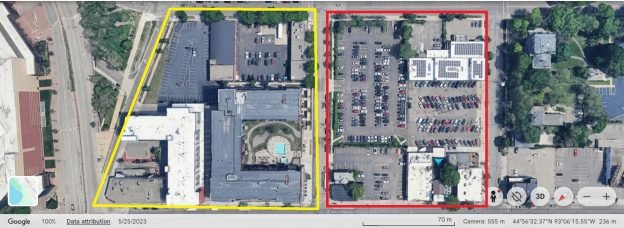
An aerial view of the same square blocks pictured above. This map includes data from: Google Imagery from the dates: 5/25/2023
I used Ramsey County’s Property Tax and Value Lookup tool to compile a list of all the separate tax parcels in each of these square blocks. Here’s what I found:
In 2025, the assessed taxable market value of all the land and buildings in the square block on the right (just over 3.6 acres, outlined in red above) was $7,079,700, for a combined Tax Value Per Acre of $1,957,342.
The 2025 assessed taxable market value of the land and buildings in the other square block (just over 4.1 acres, outlined in yellow above) were $60,386,600. This equates to a Tax Value Per Acre of $14,610,840 — about 7.5 times as much as the Burger Moe’s square block.
Further south and west down West Seventh Street (between Daly and Toronto Streets) is a cute little row of two-story commercial buildings. These buildings are home to Joe and Stan’s Pub and Grill, The Center for Lost Objects, the North Garden Theater and a few other businesses.
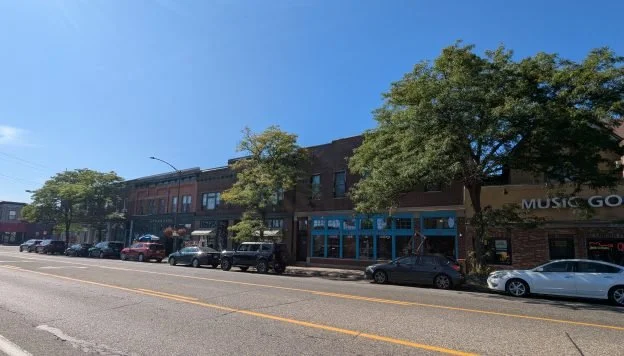
A charming block of pedestrian-oriented mixed-use buildings along West Seventh Street, between James Avenue and Toronto Street. Photo credit: Luke Hanson
Once again, I looked up the sum of these parcels’ taxable market values in 2025 ($3,881,200 from the corner building to the North Garden Theater) and their combined area (just under 0.71 acres) using the County’s lookup tool. Their combined Tax Value Per Acre is $5,478,826.
Obviously, these two-story buildings produce a fraction of the Taxable Value Per Acre that the five-story Hampton Inn and the six-story Oxbo Apartments do. But notice something else: they produce about 2.8 times as much Tax Value Per Acre as the Burger Moe’s square block does. Building Saint Paul’s tax base through dense real estate development isn’t just about five- and six-story buildings; there’s plenty of opportunity to grow the tax base by building compact, land-efficient two- and three-story buildings as well.
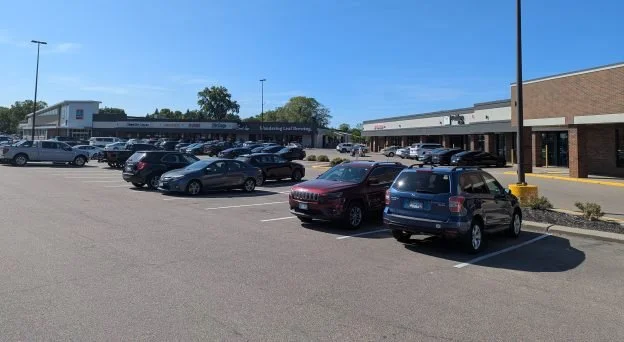
The Sibley Plaza strip mall on West Seventh Street. Photo credit: Luke Hanson
Finally, here’s the Sibley Plaza strip mall, home to Aldi, Wandering Leaf brewery, Planet Fitness and more. The buildings and their parking take up 7.46 acres of land, and had a 2025 taxable market value of $10,725,000. This amounts to a Tax Value Per Acre of $1,437,648 — less than a third of the Per Acre productivity of the humble two-story storefronts, and less than 10% of the Per Acre productivity of the Oxbo/Hampton Inn square block.
These examples make it clear: in general, the more “land-efficient” a building is, the more Tax Value Per Acre it generates. Surface parking lots and lawns produce very little taxable value, and so one-story buildings with massive parking lots (like the Aldi strip mall) contribute relatively little to our City’s fiscal wellbeing. Even two-story, “Main Street-style” shops produce far more Tax Value Per Acre than the strip mall does, even as they provide parking spots behind their buildings. And taller buildings with greater lot coverage (like the Oxbo Apartments and the Hampton Inn & Suites) produce dramatically more.
There’s an obvious relationship between the tax productivity of a parcel of land and the square footage of its buildings. The square block occupied by the five-story hotel and the six-story apartments generated about three times as much Tax Value Per Acre than the parcels with the two-story buildings.
To borrow a term from urban planners, the higher a parcel’s Floor Area Ratio– the total finished square footage of the buildings on a parcel of land, divided by that parcel’s area– the higher its Tax Value Per Acre is likely to be. I’m not claiming this as some kind of universal rule; of course there are other factors that impact real estate values, like location and the age of buildings. But as a general rule of thumb, I think it’s abundantly clear that densely developed land does far more to support our City’s collective fiscal resilience than sparsely developed land.
Legalizing a Change
Let me recap the key points I’ve made so far:
The taxable market value of all the land and buildings in Saint Paul isn’t enough to meet our city’s needs– that’s why property taxes keep surging even as the City struggles to maintain infrastructure and services.
We need real estate development that results in more taxable value in the same finite amount of space– more Tax Value Per Acre.
In general, “dense,” compact, land-efficient real estate development generates far more Tax Value Per Acre than “sub-urban,” single-story real estate development with large lawns and surface parking lots.
We need to encourage more dense development throughout Saint Paul to increase our tax base and escape our fiscal bind. But before we can encourage the type of development that will rapidly expand our tax base, we have to make it legal in more places around Saint Paul.
The City of Saint Paul has taken steps to enable slightly denser, more tax-productive development in recent years. Most notably, it legalized 2- to 6-unit residential buildings in almost every residential area of Saint Paul, and allowed for “thicker,” more land-efficient development by increasing the maximum allowable height and lot coverage rules. These changes are great, but they are designed to enable very gradual, incremental change over decades; they don’t allow the kinds of real estate development that will yield ten- and twenty-fold “leaps” in Tax Value Per Acre on individual parcels that will accelerate our efforts to climb out of our fiscal hole.
Buildings at the southeast corner of Selby Avenue and Dale Street. The Avandale Apartments is pictured on the left. Photo credit: Luke Hanson
The recent construction of the Avandale Apartments on Selby Avenue enabled one such a leap in tax base expansion. Before the apartments were constructed, this parcel was a grassy lot, and contributed very little to Saint Paul’s tax base; in 2023, its Tax Value Per Acre was just $871,157. In 2025, after the apartments were constructed, the parcel’s taxable value was $16,933,200 — $26,159,750 in Tax Value Per Acre, more than a thirty-fold increase. If a one-, two- or three-story building had been built here instead, the result would have been a fraction of the Tax Value Per Acre, and ultimately a fraction of the additional tax revenue that this parcel had the potential to produce for the City every year.
It is not enough that we modestly pick up the pace of expanding our tax base. Our city has been falling further and further behind its growing fiscal needs for decades: we need to sprint to catch up. To accomplish this, we need to rezone land in many more places around Saint Paul to allow for higher-intensity development, including four, five, and six-story buildings. Right now, the City’s zoning rules disallow mid-rise buildings in all but a few small areas. In this way, our City’s own policies are directly and explicitly at odds with its most obvious means of expanding the tax base. We have made it illegal to do the most obvious thing we can do to solve our fiscal crisis. It’s time that we get out of our own way.
I don’t mean to suggest that the single step of rezoning for denser development will suddenly unleash a massive surge of construction across Saint Paul and a quick resolution to the City’s tax base challenges. The vast sub-urban superblocks along the Green Line in the Midway are a strong example. Almost the entire area from Snelling to Lexington between University Avenue and Interstate 94 was rezoned over a decade ago to enable mid-rise buildings; since then, the only new mid-rise buildings are The Nine at Lexington Station and two buildings under construction by Allianz Field (a hotel and an office building). There are numerous other factors that limit the speed and scale of real estate development — some which the City has power to change (e.g. local policies and bureaucratic processes) and some that the City is essentially powerless to change (e.g. interest rates, lumber prices, construction worker shortages).
Rezoning land is not the only step to catalyzing tax base growth in Saint Paul, but it is the first step. And the fact that a parcel might not get redeveloped for years after it is rezoned should only motivate us to take this first step as soon as possible, and then to get to work on tackling other obstacles. Higher-intensity development won’t happen at all in locations where it isn’t legal.
Here’s some good news: the City Council has already directed the Planning department to develop a plan for rezoning land along six major streets which are served by Arterial Bus Rapid Transit Routes (or which will be in the next few years). In the next week or two, I’ll publish two more essays discussing that zoning study and the opportunity that it presents to enable compact, pedestrian- and transit-oriented development that grows the tax base and makes Saint Paul a better place.
In the meantime: if you’d like to join others in advocating for better zoning policy in Saint Paul, please fill out this form to get connected with Sustain Saint Paul’s Housing, Zoning, and Development Committee! We’d love to connect. (Also be sure to subscribe to Sustain Saint Paul’s email newsletter.)
This article has also been published in Streets.mn at this link, and we highly suggest you give them a click.